“How about taking a walk in the nature?”
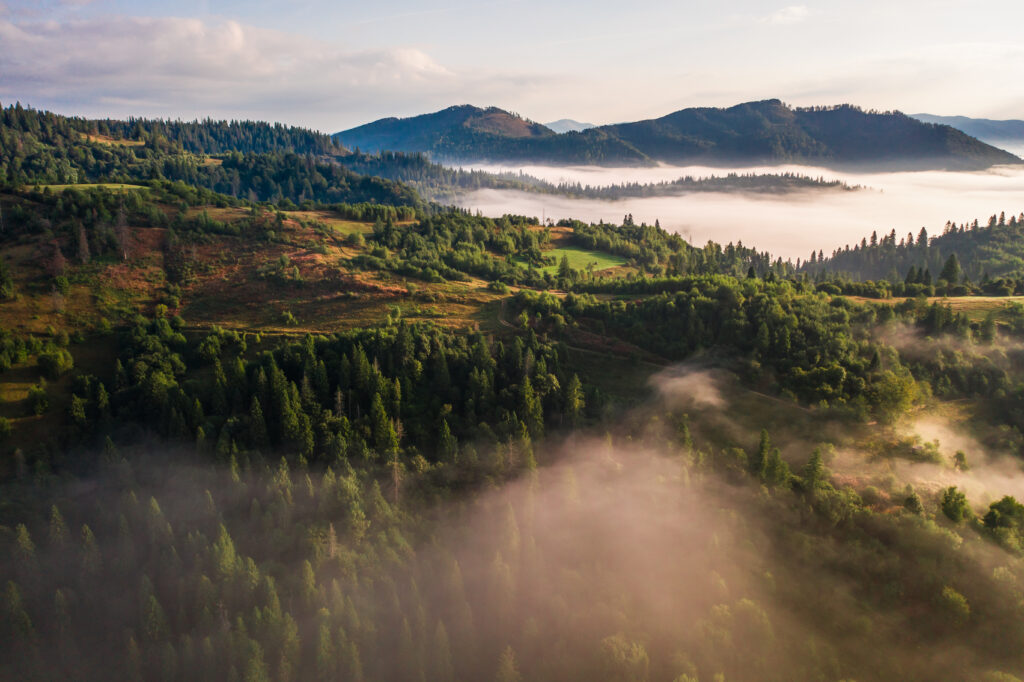
One of the first things I noticed about typical Finnish English is that many people tend to say “the nature” when they are talking about the natural world around us, otherwise known as the great outdoors. This is also true of many Swedish speakers and German speakers and many speakers of some other languages. But the problem here is that in English we just say “nature” when we mean the world outside our towns and cities.
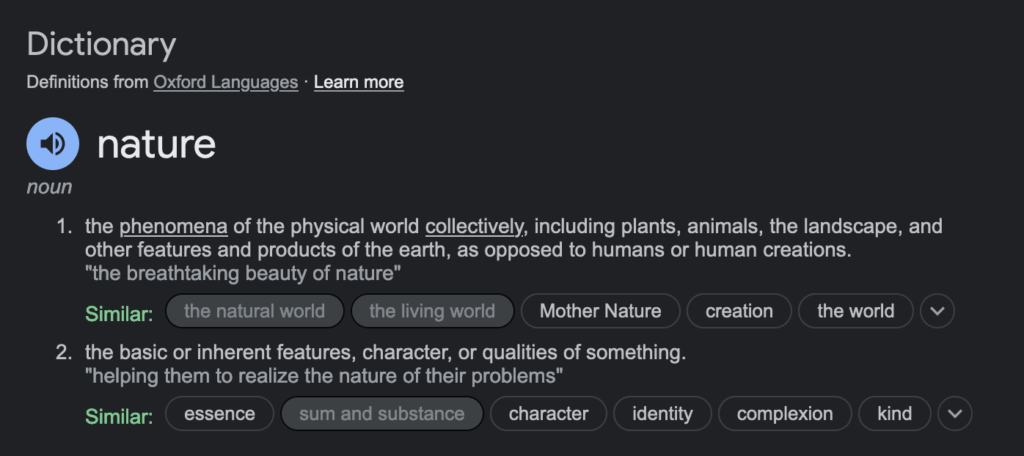
This is an easy mistake to make, especially for speakers of a language like Finnish that doesn’t tend to use articles— “a,” “an,” “the” —before nouns. But even when you are aware of general English rules of usage, there is no easy way to figure out whether to use “the” before “nature.” One common understanding is that you don’t use an article for large abstract or indefinite concepts that cannot be counted, such as “heaven,” “money,” “sugar,” and—as it turns out— “nature.” You wouldn’t say “I can’t wait to get to the heaven” or even “a heaven” because the word “heaven” refers to something which in common Anglo-European thinking, dominated for centuries by Christian perspectives, cannot by definition be counted because there is only one heaven. In the early Renaissance, on the other hand, it was quite common to speak of a number of heavens: “I am in seventh heaven!”
You would say “I love money” because in this case you just mean money in general. But if I owe you money, you could and would say “Give me the money!” In this case, we are both speaking about a certain amount of money and not just money in general. In the same vein, you would say “I love sugar” when you mean sweet foods in general (I will talk about when to say “foods” rather than “food” in another post), but if we were sitting together at the dinner table you would say, “Please pass the sugar.” You don’t want all the sugar in the world at this moment but that particular amount of sugar in the sugar bowl.
Things get more confusing, though, when we say “I love the world.” The world is big and general, just like nature, but we nevertheless say “the” world and not “I love world.” We say “I love the city” even when we mean city life and not a specific city—we don’t say “I love city.” But if we love the world outside the city, we say “I love nature.” Danged if I know why!
The Nature of a Thing
Perhaps even more confusing is that we can and do say “I love the nature of sugar” or “I love the nature of politics” or even “I love the nature of nature.” In this case, the phrase “the nature” refers to a set of qualities specific to a given thing, such as ducks or donuts or dirigibles. In the case of this particular post, you could say that I love the nature of unexpected quirks of language, especially when they pose difficulties in translation.
In practice, of course, native English speakers would understand what you mean if you said “I like to spend time in the nature.” And unless they are acting as a teacher or an editor of the language—like me—they would most likely be polite enough not to point out your error. But they would notice it. And depending on the nature of your writing task—ha! “the nature of . . .” !—this might or might not be a fatal mistake.
But if you want to have your writing be received as clearly and smoothly as possible, it is important to learn about and avoid such little quirks of the English language.
I explored this topic with ChatGPT
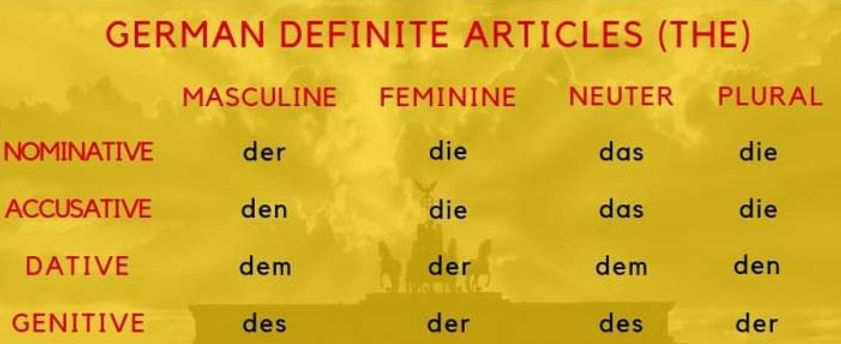
definite articles in European Languages
Hartley Edits:
I guess my real question is “Which languages typically use the definite article when referring to nature (as in the natural world)?
ChatGPT:
The key distinction is not “languages that translate nature with the,” but languages whose article system treats broad abstract or mass nouns as definite more readily than English does.
English
English is comparatively unusual in normally treating nature, meaning the natural world as a whole, as a proper-name-like or abstract mass noun without an article. Many European languages conceptualize the same realm with a definite article.
Here is a useful comparison:
| Language | Ordinary expression | Literal rendering |
| English | nature | nature |
| German | die Natur | the nature |
| French | la nature | the nature |
| Spanish | la naturaleza | the nature |
| Italian | la natura | the nature |
| Portuguese | a natureza | the nature |
| Dutch | de natuur | the nature |
| Greek | η φύση (i físi) | the nature |
| Swedish | naturen | the-nature |
| Danish | naturen | the-nature |
| Norwegian | naturen | the-nature |
| Finnish | luonto | nature—Finnish has no articles |
| Russian | природа (priroda) | nature—Russian has no articles |
romance languages
In French, Spanish, and Italian, the pattern is especially systematic: general concepts, abstract nouns, and entire classes commonly take the definite article, even where English uses none:
- French: La nature est belle.
- Spanish: La naturaleza es bella.
- Italian: La natura è bella.
- English: Nature is beautiful.
French grammar, for example, uses the definite article when a noun denotes a concept or class as a whole; Spanish likewise generally uses it with abstract and generalized nouns. Italian follows much the same pattern.
German
German is somewhat less mechanically article-heavy than the Romance languages, but the natural world is conventionally die Natur:
- Die Natur erwacht.
Nature awakens. - Der Mensch und die Natur
Humanity and nature - die Schönheit der Natur
the beauty of nature
Scandinavian languages
The Scandinavian languages are interesting because their definite article is often attached to the noun rather than placed before it:
- Swedish natur = nature, indefinite or articleless form
- Swedish naturen = the nature / nature conceived as the natural world
Thus Naturen är vacker corresponds idiomatically to Nature is beautiful, even though its grammatical form is literally definite.
Broad Tendencies
The broad tendency is therefore:
Germanic languages other than English, the Romance languages, and Greek commonly mark “nature” as definite when it means the natural world as a unified realm. English usually does not. Languages without articles, such as Finnish and most Slavic languages, cannot make this distinction through an article.
This is not merely a matter of translating die/la/de as “the.” It reflects a difference in how languages grammatically package a general concept. German die Natur presents nature as the identifiable totality of the nonhuman or more-than-human world. English simply lets Nature/nature name that totality directly.
There are exceptions according to sentence structure. German can omit the article in fixed expressions and compounds, while Romance languages sometimes lose it after certain prepositions or in established phrases. But as a baseline vocabulary entry, it is useful to learn:
German die Natur ≈ English nature, not normally the nature.
And therefore:
die atemberaubende Schönheit der Natur
the breathtaking beauty of nature
As you have intuited earlier, der Natur (here in the genitive case) is grammatically “of the nature,” but idiomatic English converts the entire phrase to “of nature.”
Links: